
Firms most exposed to AI have not been firing young workers. They have simply stopped hiring as many, and the bill may arrive a decade from now.
Ask a graduate recruiter what has changed since ChatGPT arrived and you rarely hear about layoffs. You hear about the junior analyst who resigned and was never replaced, and the intake that shrank “while we see what the tools can do”.
American data now suggest this is more than anecdote. A study from the US Census Bureau, drawing on records that cover almost every private employer in the country, finds that in the industries most exposed to AI, employment of 22- to 24-year-olds has fallen by about an eighth compared with less exposed industries. Nobody was shown the door. Fewer were let in.
The gap opened almost as soon as ChatGPT was released, and it is widest where someone left and a young worker would normally have taken their place. Workers in their late twenties and early thirties were far less affected.
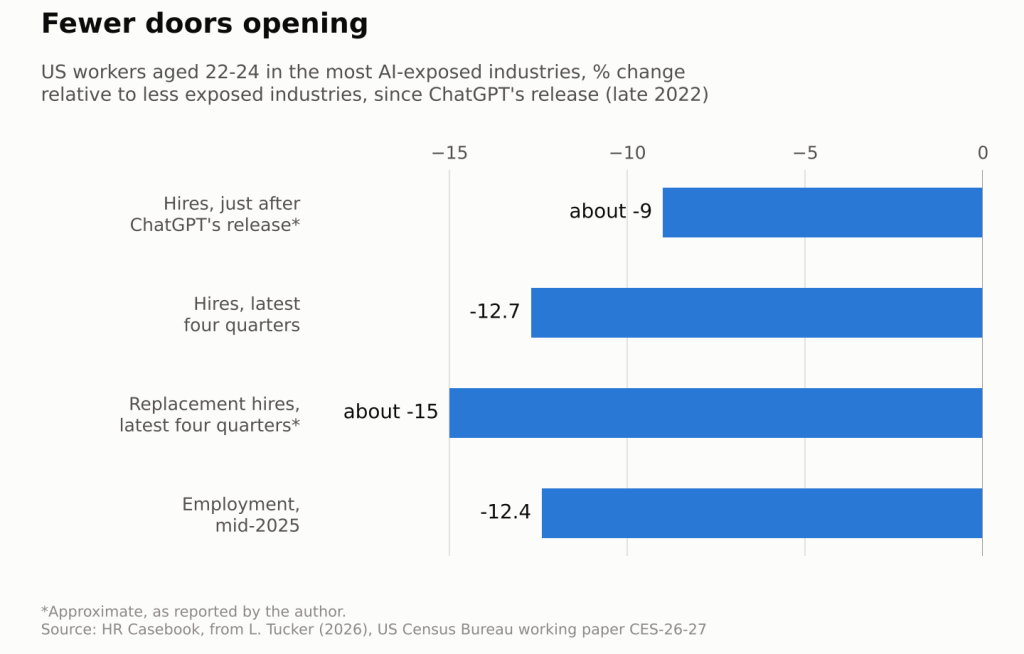
Whether AI is the culprit is less certain. The study’s author notes that young people’s prospects began to slip around the start of the pandemic, and that remote work and interest rates muddy the picture. AI is a plausible suspect; it has not been convicted.
For anyone who manages people, the more interesting question is what the slump says about how hiring decisions get made. Most are not grand strategic choices. A junior resigns, a manager wonders whether software might cover the work, and the vacancy quietly lapses. Each decision is sensible. Together they add up to a workforce strategy that nobody actually chose, sometimes on the strength of productivity gains that are expected rather than proven.
The cost shows up later. Junior jobs are where professionals learn the trade: drafting the first version, checking the numbers, sitting quietly in meetings they will one day run. If machines do the drafting, who does the learning? A firm that stops hiring 23-year-olds must eventually grow its leaders some other way, or buy them from rivals who kept training theirs, usually at a premium.
That matters all the more in parts of Asia, where many large employers still hire graduates in a single annual intake and grow their own managers over decades. A thin cohort today means a thin bench of leaders in fifteen years.
The remedies are unglamorous: who signs off a replacement hire, how big the graduate programme is, and whether junior roles are redesigned so that the work AI absorbs is replaced by work that builds judgement.
Firms that stop hiring juniors may save money this year. In a decade, they may find that their succession plan is artificial too.
Sources
Tucker, L. C. (2026). You’re (not) hired: Artificial intelligence and early career hiring in the Quarterly Workforce Indicators. US Census Bureau, Center for Economic Studies Working Paper CES-26-27, April 2026.


Leave a Reply