
Publishing pay ranges tells employees more than their salary. It also tells them how far they have left to climb.
Pay transparency has mostly been argued over at the hiring stage. Should a job advertisement show a salary range, and does showing one narrow the gender gap? Less has been said about what happens once the range is in plain view of the people already doing the job. Each of them can now work out, to the last dollar, where they stand.
A study published this month in the Academy of Management Journal suggests that this calculation matters more than employers might assume. Its authors, Meredith Woehler of Purdue University and Tae-Youn Park of Sungkyunkwan University in Seoul, argue that employees read their position within a published range less as a statement about the present than as a forecast of the future.
The authors call this “structural pay standing”: where an employee’s pay sits between the published minimum and maximum. It differs from the familiar habit of comparing one’s salary with a colleague’s. The comparison is with the structure itself.
Those near the minimum take it as a sign that their contribution has yet to be recognised. Those near the maximum see little room left to grow (“the Ceiling Effect”). Both, in the authors’ account, are troubled by the same thing: uncertainty about future pay growth. The resulting relationship is curved. Moving up from the bottom of a range improves job satisfaction, the intention to stay and job performance, but the gains flatten as employees approach the top. Where employees judged the process behind pay decisions to be fair, the effects were weaker.
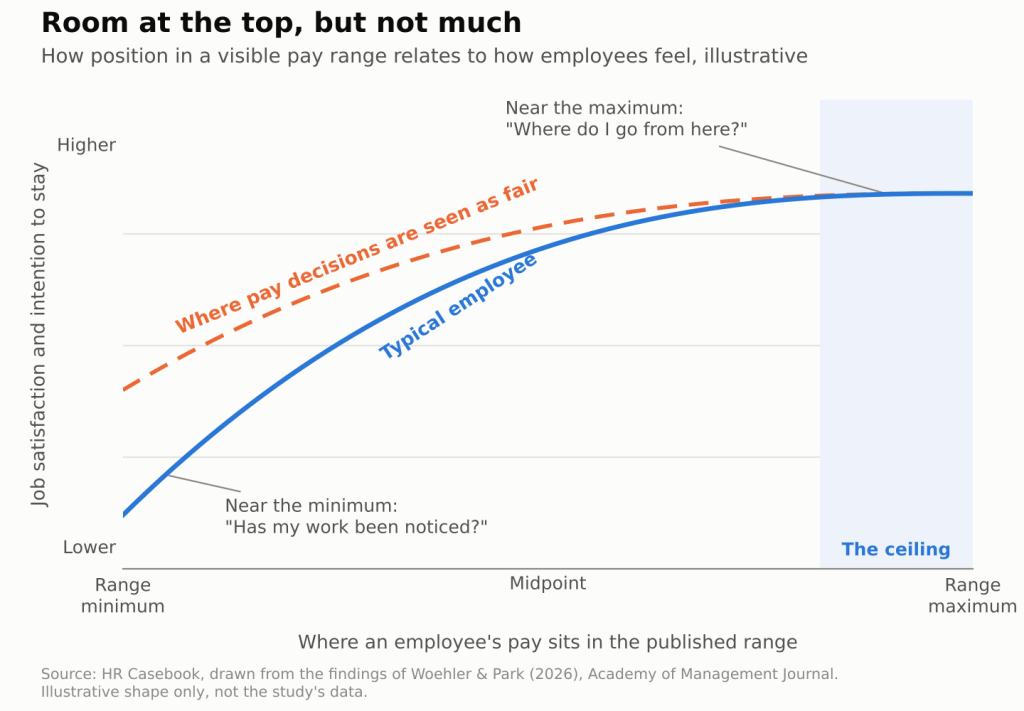
The evidence comes from four studies: a natural experiment with 371 participants, an online experiment with 603, a three-wave field study of 525 employees and a further experiment with 392. That different designs point the same way lends the result some weight. The paper is only days old, and this account rests on its abstract, which reports neither effect sizes nor the countries in which each study was run.
It does fit with earlier work. In 2021 Kathrin Schnaufer and colleagues, writing in the Journal of Organizational Behavior, found that when a technology company moved from pay secrecy to transparency, employees who discovered that they stood lower than they had expected became less satisfied, with envy playing a part. Transparency does not create inequity. It merely makes existing positions harder to ignore.
The finding has particular resonance in Asia. Structured pay bands are a fixture of the region’s big employers, from the job-grade systems of Korean and Japanese conglomerates to the broadbands favoured by multinationals’ hubs in Singapore and Hong Kong. Until recently few employees knew where they sat within them. That is changing. The EU’s Pay Transparency Directive gives workers the right to request information on average pay levels for their category of work, and global firms often find it simpler to apply one policy everywhere than to run several.
The practical consequence is that the compa-ratio, long a technical measure confined to rewards teams’ spreadsheets, becomes something employees can see for themselves. Two groups stand out: those who linger near the bottom of a range well after joining, and those who have reached the top. For the first, the research points to clarity about how and when pay progresses. For the second, it points to candour about what comes next, whether a promotion, a broader role or rewards that do not depend on base pay. And the finding on procedural fairness suggests that explaining how pay decisions are made may count for almost as much as the decisions themselves.
Pay transparency is usually discussed as a matter of compliance. This research suggests it is also a matter of communication: a published range tells every employee a story about their prospects, whether or not the employer meant to tell one. Show people the ceiling, and they will start looking for the stairs. Or the exit.
Sources
Woehler, M. L., & Park, T.-Y. (2026). The consequences of pay standing under pay range transparency. Academy of Management Journal, published online November 2026.
Schnaufer, K., Christandl, F., Berger, S., Meynhardt, T., & Gollwitzer, M. (2021). The shift to pay transparency: Undermet pay standing expectations and consequences. Journal of Organizational Behavior. https://doi.org/10.1002/job.2575


Leave a Reply