
France cut its working week a quarter of a century ago. New research suggests the hours fell, productivity rose, and somebody else paid the bill.
South Korea is talking itself into a shorter week. The government has set up a task force of unions, employers and experts to plan a four-and-a-half-day week, and it now offers support to smaller firms that cut hours without cutting pay. The early signs look good: almost all of the firms that joined the scheme this year trimmed at least two hours a week, mostly by giving more paid leave.
Anyone weighing the idea would do well to look at France, which tried something bolder in 2000. It cut the standard week from 39 hours to 35, with no cut in monthly pay. A new study by five economists, published in October by the National Bureau of Economic Research, uses company and employee records to work out what actually happened, and separates the effect of the shorter week from the generous payroll-tax cuts that came with it.
The headline is reassuring. Total hours fell by about 6%, but output fell by only 1%, because firms became more productive. The package as a whole cost no jobs.
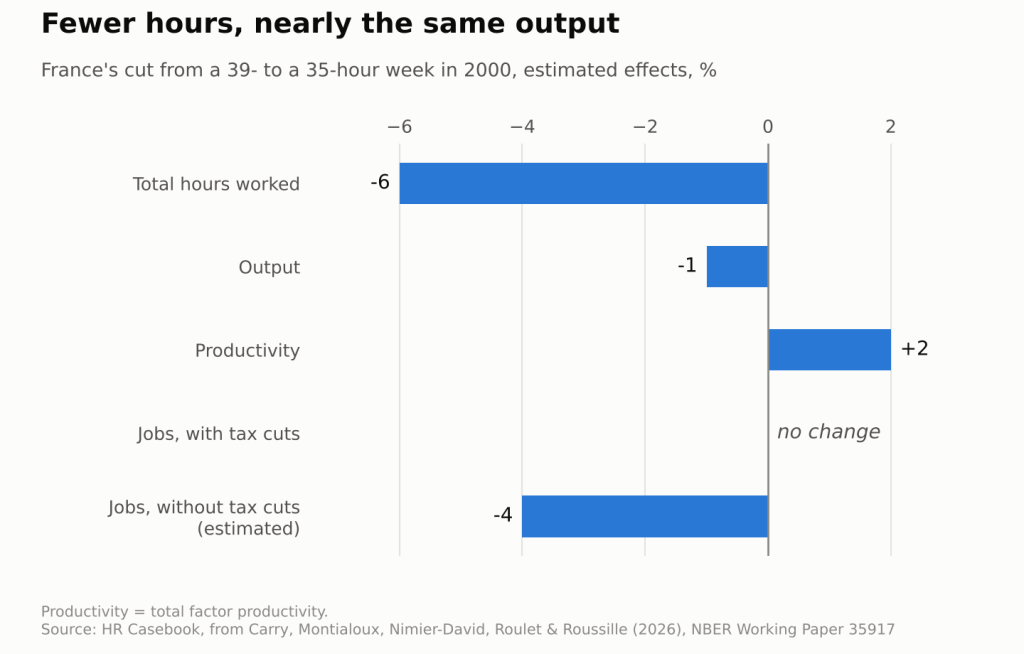
The detail is less comfortable. Without the tax cuts, the authors estimate, the shorter week on its own would have cost jobs. The state, in effect, bought them back. Nor were the gains evenly shared: employment rose among managers and professionals and fell among everyone else. And surveys from the time suggest the extra productivity came partly from reorganising work and partly from people simply working harder in the hours that remained.
France in 2000 is not South Korea today, and a legal mandate is a different beast from a voluntary, subsidised scheme. But the questions the study raises travel well.
The first is what a shorter week is for. If the hours vanish but the workload does not, the result may be a more intense week rather than a better one, which is hardly the point of a reform sold on wellbeing. Output is easy to measure. Whether people are more rested, or merely more rushed, takes more effort to find out, and is rarely checked.
The second is who it is for. A shorter week is easy to arrange for an office team and much harder for a production line, a hospital ward or a shop floor, where someone has to cover the missing afternoon. France hints at what happens when that is overlooked: the benefits flow to those whose work is easiest to compress.
The third is what happens when the money stops. South Korea’s support, like France’s tax cuts, cushions the transition. The firms most likely to keep a shorter week are those that use the cushion to redesign how work is done, rather than squeezing the same work into fewer days.
Shorter weeks, it seems, take a long time to get right.
Sources
Carry, P., Montialoux, C., Nimier-David, E., Roulet, A., & Roussille, N. (2026). The effects of a shorter workweek on employment, output, and productivity. NBER Working Paper 35917, October 2026.
Korea JoongAng Daily (2025). Gov’t launches task force with unions, business leaders on 4.5-day workweek. 24 September 2025.
Asia Business Daily (2026). Expansion of 4.5-day workweek among SMEs. 18 June 2026.


Leave a Reply