
The journey to work does not end at the office door. New research finds that a bad commute arrives with you, and your colleagues pay for it.
Most people have met the colleague who arrives in a mood after a delayed train or an hour in traffic, and snaps at the first person who asks a question. Until recently, researchers were sceptical that this was more than anecdote. Studies of commuting had largely concluded that its effects on behaviour at work did not run through people’s emotions.
A study in the December issue of the Journal of Applied Psychology argues that earlier work was simply looking for the wrong emotion. Tracking employees’ commutes and moods day by day, the authors found that demanding journeys were linked to a specific state: irritability, a restless, edgy feeling without an obvious cause. And mornings that started irritable were followed by more bad behaviour towards colleagues during the day.
The researchers also tested two simple remedies. The clearer result came from the simpler one: listening to relaxing music after arriving weakened the link between a stressful commute and the irritability that followed.
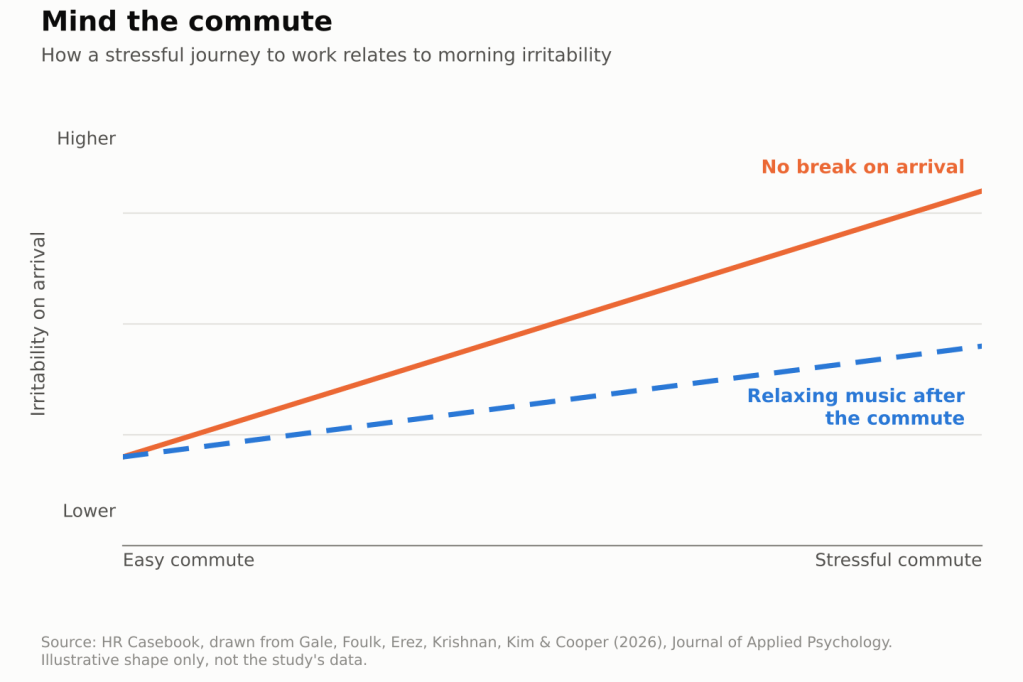
It is a single study, and the abstract does not say where or among whom it was run, so the size and reach of the effect remain open. But the mechanism is plausible, and the remedy is cheap.
The more interesting point for employers is where the cost lands. The commute is unpaid time and, officially, none of the company’s business. Yet if it shapes how people treat each other once they arrive, it is a workplace issue in all but name. Its price is paid not by the commuter alone but by the colleague on the receiving end of a sharp reply, and by a team whose morning starts on the wrong foot.
That matters more as firms call staff back to the office. In many of Asia’s big cities, from Jakarta to Manila to Seoul, long and crowded journeys are part of daily life. A return-to-office policy is usually justified by collaboration and culture. This research raises the possibility that, on the days the journey is hardest, the commute itself may chip away at both. Few return-to-office decisions weigh that cost explicitly.
Nor is the burden evenly shared. Those with the longest journeys are often the people least able to live near the office. Flexible start times, a choice of which days to come in, and a quiet first half-hour rather than a meeting at nine all cost little, and may do more for collaboration than another policy memo.
Companies spend heavily on what happens once employees reach their desks. This study is a reminder that some of the day’s work is already done, or undone, before they get there.
Sources
Gale, J., Foulk, T. A., Erez, A., Krishnan, S., Kim, H.-L. R., & Cooper, B. (2026). From road to rage: Why commute demands are associated with interpersonal counterproductive work behaviors (and what to do about it). Journal of Applied Psychology, 111(12), 1831-1843.


Leave a Reply