
Being the person colleagues turn to for advice leads to recognition and promotion. A new study finds women can get there as easily as men, but only by doing more for others first.
Every team has one: the person everyone asks. They know how the system works, which client is touchy, how to fix the spreadsheet. Being that person pays. Colleagues come to see them as leaders, and managers tend to rate their performance more highly. The question is who gets to become that person, and on what terms.
A study published in September in Personnel Psychology, by researchers from Tsinghua University, Huazhong University of Science and Technology and Ohio State University, looked at this in a male-dominated industry in China, and then tested the idea in two online experiments. In the workplace study, women were less likely than men to be the colleague others sought out for advice. The gap closed among women who were strongly driven to help others. For men, that drive made little difference: they were sought out anyway.
Once someone became a go-to adviser, the rewards were much the same whatever their gender: more recognition as a leader and better performance ratings. The inequality, in other words, lay not in what being central earned, but in what it took to get there.
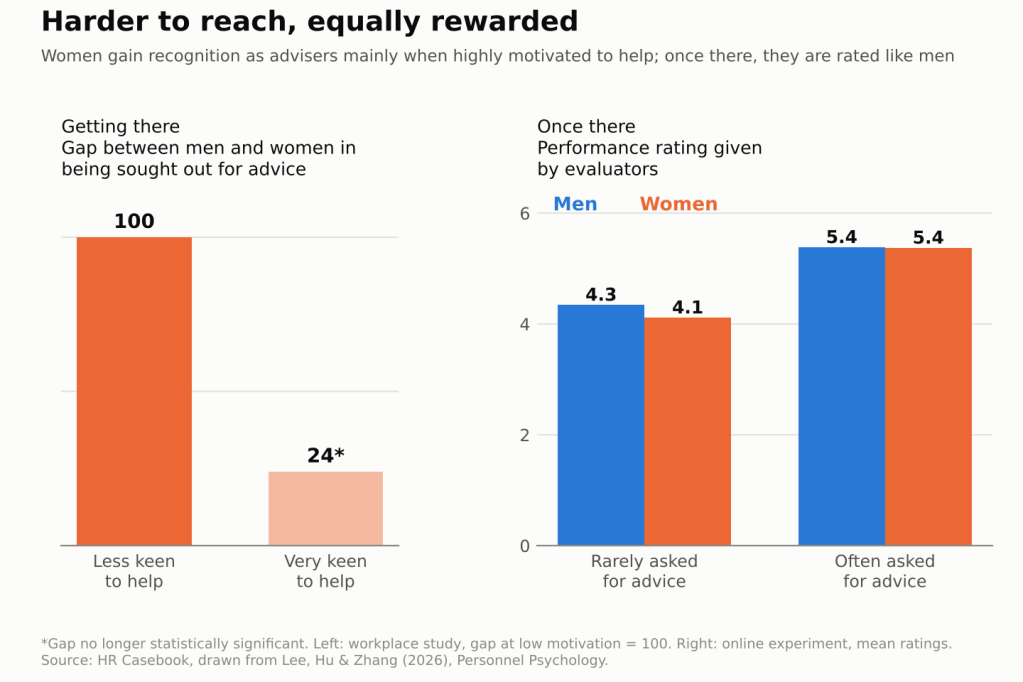
The field study was small and set in one demanding context, but the experiments pointed the same way. The authors draw a sober conclusion: equal outcomes can rest on unequal effort. Women may need to invest more time and attention in colleagues’ problems before their expertise is trusted, while men’s is largely assumed.
That has an uncomfortable implication for familiar advice. Telling women to be more visibly helpful may work for the individual, but it treats a structural problem as a personal one, and quietly adds to the load. The authors argue the burden should not rest on women alone but on how organisations decide whose expertise counts.
For anyone involved in performance reviews or promotion panels, the study points somewhere specific. Much of what passes for merit in those discussions is informal reputation: who is “go-to”, who people “rely on”. This research suggests that reputation is not conferred on equal terms. Questions follow. Whose advice is sought in meetings, and whose is bypassed despite the relevant expertise? Is helping colleagues counted as work, or treated as a pleasant personality trait? And when a calibration meeting praises someone for being generous with their time, is anyone asking what that generosity cost them?
Equal pay for equal work is a familiar slogan. Equal credit for equal expertise may prove the harder sell.
Sources
Lee, H., Hu, J. J., & Zhang, P. (2026). Closing the gap, carrying the burden: How gender and prosocial motivation shape workplace recognition. Personnel Psychology, 79(4), 613-634.


Leave a Reply