
Companies love to onboard graduates in cohorts. New research suggests the friendships formed there may be steering newcomers towards the exit.
Every September the same scene plays out in office lobbies from Shanghai to Singapore: a crowd of new hires in fresh lanyards, ushered into an induction week together, sharing a chat group by lunchtime. It looks like good onboarding. They have instant friends, someone to ask about the coffee machine, and a sense of belonging from day one.
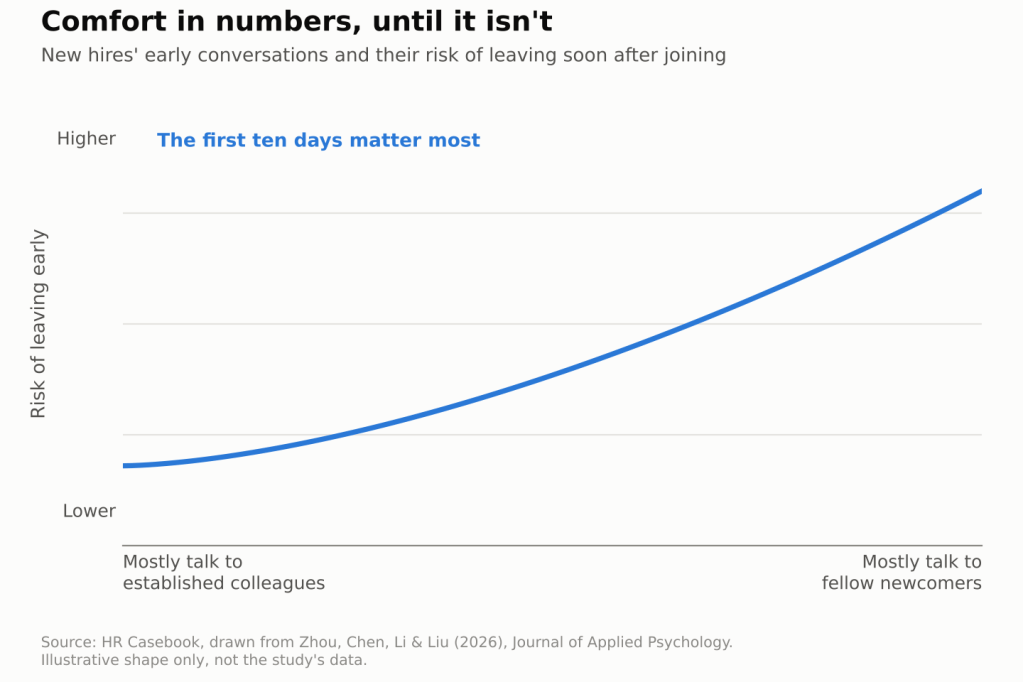
A study published in August in the Journal of Applied Psychology suggests that comfort may come at a price. Researchers from Tsinghua University analysed the daily workplace communications of more than 8,000 newcomers at a large technology firm, and how they interacted with nearly 20,000 established employees. Those who spent a disproportionate share of their early conversations with fellow newcomers, rather than with people who had been there a while, were more likely to leave soon afterwards.
The window for getting this right was strikingly short. The first ten days proved especially decisive. Early patterns tended to reinforce themselves: newcomers who started inside a bubble of peers drifted to the edge of the organisation’s real networks, and stayed there. Conversations with newcomers in other units were especially unhelpful.
It is one firm, and communication data show who talks to whom rather than what is said. But the scale is unusual, and the finding runs against a cherished assumption of graduate programmes.
That assumption is that belonging comes from peers. In a sense it does: a cohort offers solidarity and someone to grumble with. Yet belonging to a cohort is not the same as belonging to an organisation. Fellow newcomers know as little as you do about how things really work, who decides what, and whom to ask. A newcomer who spends the first fortnight among other newcomers may feel settled while remaining, in practice, an outsider.
The question for anyone designing onboarding is therefore not whether new hires feel welcome, but whom they feel welcome with. Large annual intakes, common among employers in China, South Korea and Japan, make cohort-based induction efficient and almost inevitable. The study hints that the more useful investment may be in the less tidy part: the first ten days of introductions to established colleagues, the manager who makes time in week one rather than week six, and the experienced peer who is asked, and given time, to pull a newcomer into real work.
Hybrid work raises a further question the study does not answer. If new hires and veterans rarely share a floor, the natural drift may be towards the people who arrived on the same day and share the same chat group.
So what might companies do about it? The peer-bubble study stops short of prescriptions, but wider research offers some prompts. A meta-analysis of 83 field experiments found that newcomers who went through a structured onboarding programme were more likely to stay, and that the gains were largest when programmes deliberately helped people integrate socially and were spread over weeks rather than crammed into a single induction. Should the first fortnight, then, include planned introductions to veterans rather than yet more time with fellow recruits? Could every graduate be paired with an established colleague from another team, alongside the customary cohort buddy? Would short rotations or cross-team projects widen the circle faster than any welcome lunch?
The choice of mentor may matter as much as having one. A 2024 study in the same journal found that career mentoring from someone other than the newcomer’s own manager could backfire, nudging recruits to weigh what the outside market might offer. If mentoring is part of the answer, is the line manager the right person to provide it, and is that manager given the time? And might HR simply check, a month in, whom new hires are actually talking to?
Birds of a feather flock together. In the first fortnight of a new job, it seems, they may also fly off together.
Sources
Zhou, H., Chen, J., Li, N., & Liu, J. (2026). The perils of peer bubbles: How early newcomer communication network composition shapes organizational integration and early turnover. Journal of Applied Psychology, 111(8), 1082-1095.
Liu, S., Watts, D. I., Feng, J., Wu, Y., & Yin, J. (2024). Unpacking the effects of socialization programs on newcomer retention: A meta-analytic review of field experiments. Psychological Bulletin.
Deng, H., Guan, Y., Zhou, X., Li, Y., Cai, D., et al. (2024). The “double-edged sword” effects of career support mentoring on newcomer turnover: How and when it helps or hurts. Journal of Applied Psychology.


Leave a Reply