
Block has cut jobs twice this year, the second time days after strong results. Research on the employees who keep their jobs suggests that how cuts are handled matters almost as much as the cuts themselves.
In February Block, the payments firm behind Square, Cash App and Afterpay, cut more than 40% of its staff, pointing to advances in AI. Early this month it began a second round, days after reporting that gross profit had risen by a fifth, according to Business Insider. The company has not said how many people were affected. It is hardly alone: TrueUp, a tracker, counts more than 200,000 technology jobs cut worldwide this year.
Layoff announcements dwell on those who leave. The larger group is usually the one that stays, and it is the one the company is counting on to make the leaner model work. A sizeable body of research suggests that this group pays a quieter price, and that much of the price depends on how the cuts are handled.
A study published last year in PLOS Mental Health followed Norwegian employees who kept their jobs over three years. Those whose own department had downsized were more likely to develop symptoms of anxiety and depression than colleagues in firms that had not cut. But the extra risk sat almost entirely with people who felt their views had been ignored, who had no chance to talk to their manager about what the change meant for them, or who had not been trained for their new tasks. About one in six of them developed distress. Among those who felt involved, it was one in twenty, barely different from employees whose firms had made no cuts at all.
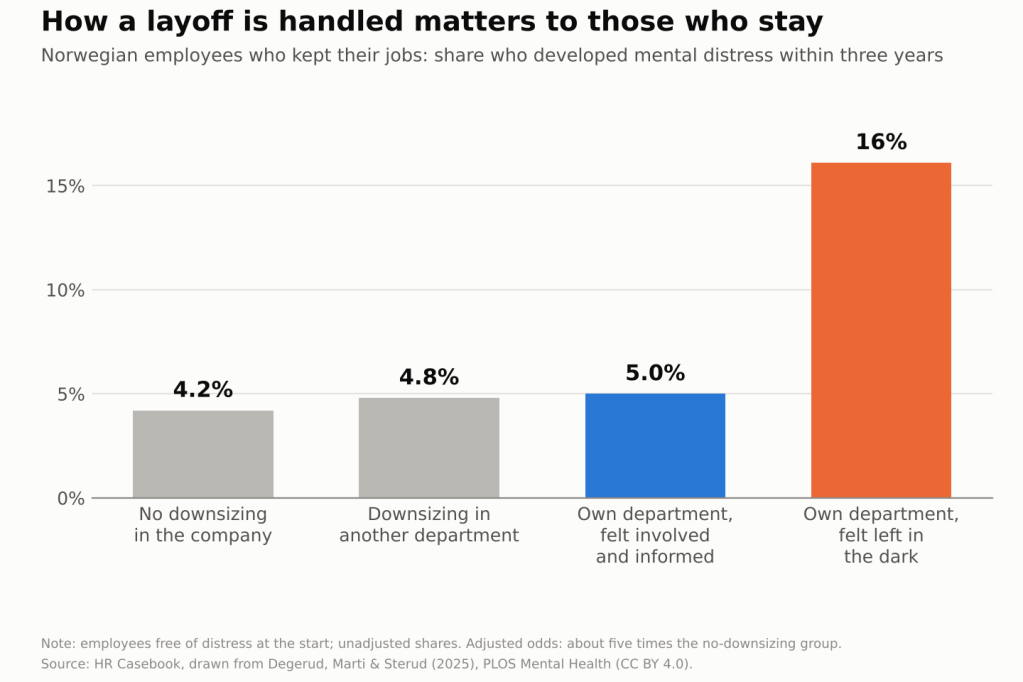
The caveats are the usual ones. These are survey answers, and people who were already unhappy may have judged the process more harshly. Still, the pattern fits older work. Moore and colleagues (2004), following workers at an American manufacturer through several waves of cuts, found no sign that people grew hardened with practice: each brush with layoffs left them less secure, keener to quit and more depressed. Trevor and Nyberg (2008) found that firms which downsized saw voluntary quit rates rise afterwards, less so where HR practices signalled fair procedures or bound people more firmly to the organisation.
That is why a second round matters. One cut can be presented as a reset. Two in a year, the second following good news, send a different message: that reductions are now routine, whatever the results. For survivors, the sensible response is to keep a CV warm, and those with the best outside options, often the people a firm most wants to keep, are best placed to act on it. Spreitzer and Mishra (2002) found that survivors who trusted management and judged the process fair were more attached to the firm and less likely to leave in the following year.
Which raises some practical questions. Does every employee whose team has shrunk get a proper conversation with their own manager about what it means for their job, rather than a town hall and a list of answers to frequently asked questions? When work is redistributed, who checks that people have been trained for the tasks they inherited? Are survivors asked how the new structure should work, as the Norwegian measures imply they should be? And when a second round follows the first, does anyone tell those who remain whether more is coming, even if the honest answer is that nobody yet knows?
Severance packages are carefully costed. The price of leaving the survivors in the dark rarely appears on any spreadsheet, which is not the same as saying nobody pays it.
Sources
Degerud, E., Marti, A. R., & Sterud, T. (2025). Association of company downsizing with the risk of mental distress among employees in the Norwegian working population. PLOS Mental Health, 2(6), e0000247.
Moore, S., Grunberg, L., & Greenberg, E. (2004). Repeated downsizing contact: The effects of similar and dissimilar layoff experiences on work and well-being outcomes. Journal of Occupational Health Psychology, 9(3), 247.
Trevor, C. O., & Nyberg, A. J. (2008). Keeping your headcount when all about you are losing theirs: Downsizing, voluntary turnover rates, and the moderating role of HR practices. Academy of Management Journal, 51(2), 259–276.
Spreitzer, G. M., & Mishra, A. K. (2002). To stay or to go: Voluntary survivor turnover following an organizational downsizing. Journal of Organizational Behavior.
Business Insider (2026). Jack Dorsey’s Block makes second round of job cuts this year. 5 November 2026.
Beinsure (2026). Tech layoffs 2026: More than 200,000 jobs cut amid AI investment.


Leave a Reply