
A Japanese parts maker now offers school leavers and graduates the same starting pay. The harder question is whether it will hire them in equal measure.
In Japan the price of a bachelor’s degree is printed on the first payslip. Last year a new university graduate started on about 262,000 yen a month, roughly a quarter more than a school leaver, according to the labour ministry’s wage survey. Misumi, a Tokyo-based maker and online seller of machine parts, has decided to stop charging that toll. Since November it has been recruiting young people through a single, year-round “young potential” course, open to anyone from a fresh high-school leaver to someone with about three years of work behind them, with a starting salary of at least 303,000 yen a month for all of them.
The company’s announcement frames the change around artificial intelligence, which it says is reshaping industries and the way people work. Nikkei, which reported the move, called it rare in a country where pay scales still sort entrants by certificate. Misumi also intends to assess newcomers strictly from their first year and pay them according to results, rather than letting each intake move up together.
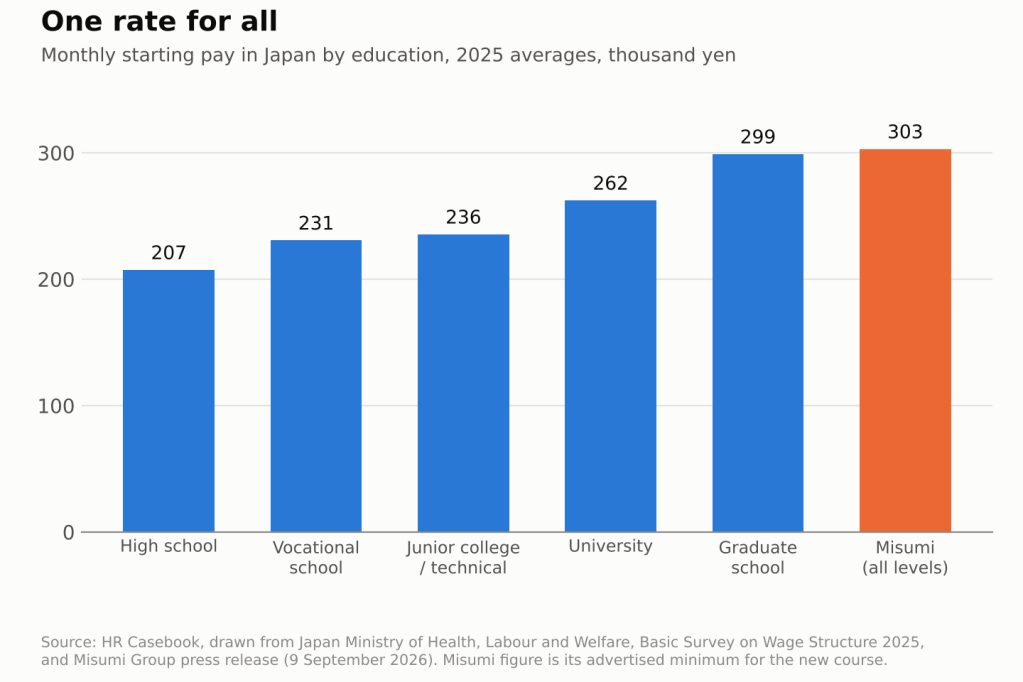
The logic is easy to admire. A degree is a proxy: it signals persistence and some general ability, but says little about whether someone can price a part, read a drawing or calm an irritated customer. If the job is the same, paying more for the proxy than for the person looks like habit rather than policy. A single rate also spares two people at neighbouring desks the discovery that four years of lectures were worth 55,000 yen a month.
The evidence suggests, however, that removing the credential from the pay scale is the easy part. A 2024 study by the Burning Glass Institute and Harvard Business School looked at American employers that dropped degree requirements from job adverts. Nearly half changed the wording but not their hiring; overall, the shift touched fewer than one hire in 700. A 2026 paper in Nature Human Behaviour found the same gap between word and deed: most firms that dropped the requirement did not go on to hire more non-graduates. Where they did, the gains were real. Workers without degrees who moved into such jobs earned roughly 12% more than comparable peers, a premium that lasted at least five years.
Habits run deep on the other side of the desk, too. In a survey experiment with German employers, graduates were nearly twice as likely as otherwise identical university drop-outs to be invited to interview, largely because employers assumed degree-holders had better job-specific and social skills. A single pay rate does nothing to an interviewer’s priors.
That moves Misumi’s real test to the parts of the process that are harder to see. Its selection runs through an AI interview, a case interview and an aptitude test. How many school leavers make it through, and how do they fare at the first review a year in? Will pay differentiation in the first year reward those who learn fastest, or quietly recreate the old premium for those who arrived most polished? And when two candidates look alike a few years on, will promotion panels still reach for the name of the university?
Employers tempted to follow might ask a few prior questions. Are the tests used to hire tied to the work itself, or do they reward the fluency that university trains? Does anyone track the share of non-graduates at each stage of the funnel, rather than only in the advert? Have managers been told why the rule changed, so that school leavers are not treated as a charity intake? The firms that made skills-based hiring stick, the Burning Glass researchers found, rebuilt how they assessed candidates instead of simply deleting a line from the job description.
A degree may still open doors in Japan. At Misumi, at least, it no longer opens the wallet.
Sources
Misumi Group (2026). 若手ポテンシャル人材の採用を通年採用・一本化へ [Young potential hiring moves to a single, year-round course]. Press release, 9 September.
Nikkei (2026). 高卒と大卒で同じ初任給、ミスミが30万円に統一 [Same starting pay for high-school and university graduates]. 3 November.
Ministry of Health, Labour and Welfare (2026). Basic Survey on Wage Structure 2025: wages of new graduates by education.
Sigelman, M., Fuller, J. and Martin, A. (2024). Skills-Based Hiring: The Long Road from Pronouncements to Practice. Burning Glass Institute and Harvard Business School.
Lyttelton, T., Nelson, D. and Wilmers, N. (2026). Decredentialed jobs and upward mobility among non-college workers in the USA. Nature Human Behaviour.
Neugebauer, M., Heisig, J. P. and Bol, T. (2025). What does successful university graduation signal to employers? A factorial survey experiment on sheepskin effects. European Sociological Review.


Leave a Reply