
Qualcomm is the latest company to link job cuts to its annual reviews. A quarter-century of research suggests a performance rating says at least as much about the rater as about the person rated.
Qualcomm’s job cuts come with an unusual label. In an October memo reported by Reuters, its chief executive, Cristiano Amon, described a “performance-focused reduction” that would follow the chipmaker’s annual reviews, with notices to staff starting this month. The memo gave no number, and said business priorities, skills and organisational needs would also count. The stated aim was a stronger performance culture.
The framing is in fashion. Meta used it in early 2025, when it cut about 5% of its workforce and described those leaving as low performers. Some of them told reporters they had received solid mid-year ratings before being marked down in the final round. Whatever the truth of individual cases, the episode showed what happens when an appraisal score is promoted from conversation starter to exit ticket.
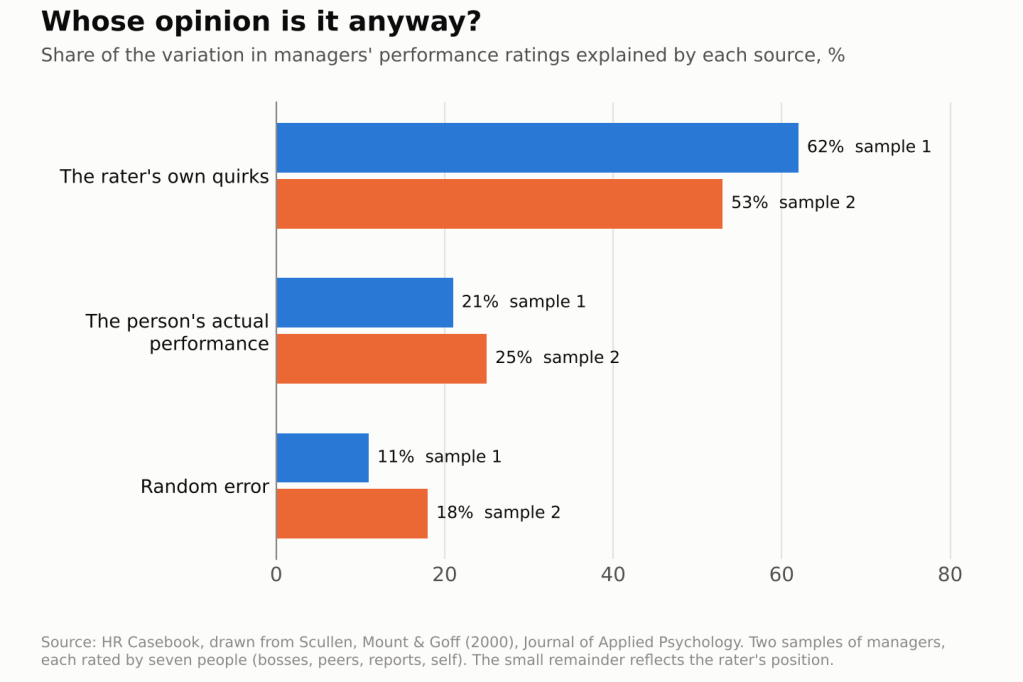
The difficulty is an old one. In a much-cited study published in 2000, Steven Scullen, Michael Mount and Maynard Goff took two large samples of managers, each rated by seven people: two bosses, two peers, two subordinates and themselves. They then asked what explained the differences in the scores. The answer was humbling. The raters’ own tendencies, how harsh, generous or particular each one was, accounted for more than half the variation in both samples. The managers’ actual performance explained only a fifth to a quarter.
Later work is kinder to the boss, but not by much. A 2024 meta-analysis that looked only at direct supervisors put the agreement between two of them rating the same person at about 0.65, on a scale where 1 means perfect agreement. An earlier review found that ratings collected for administrative purposes, the kind that feed pay and promotion, were less consistent than those gathered for research. When the stakes rise, the signal does not seem to sharpen.
None of this means that performance does not differ, or that managers should never act on it. It means that one rating, from one manager, in one cycle, is a noisy measurement. Used to decide who stays in a team of eight, the noise can easily outweigh the real gap between the fifth and sixth person. A cut of this kind also blends two questions: whether a role is still needed, and whether its holder is good at it. Labelling every departure a performance call answers the first question in the vocabulary of the second.
Those who stay pay attention too. Work by Joel Brockner and colleagues, including a 1994 study of layoff victims and survivors, shows that how fair the process looks shapes reactions on both sides of the exit door. Survivors who doubt the ratings will draw their own conclusions about what next year’s review is really for.
What would make the measurement worthier of the decision? Would ratings hold up better if several people contributed, with calibration across teams rather than only within them? Could firms separate the choice of which roles to cut from the judgement about individuals, and be candid about which one they are making? Should someone check whether people on leave, or with new managers, are over-represented among the low scores? And is it wise to brand leavers publicly as underperformers when the instrument behind the label is this blunt?
A rating is an opinion with a number attached. Before it becomes a verdict, it deserves a second opinion.
Sources
Reuters (2026). Qualcomm to cut jobs worldwide in performance-focused layoffs, internal memo shows. 20 October (via Deccan Chronicle).
Lake, S. (2025). Meta’s layoffs were supposed to affect only low performers. Fortune, 11 February.
Scullen, S. E., Mount, M. K. and Goff, M. (2000). Understanding the latent structure of job performance ratings. Journal of Applied Psychology, 85(6), 956.
Speer, A. B., Delacruz, A. Y., Wegmeyer, L. J. and Perrotta, J. (2024). Meta-analytical estimates of interrater reliability for direct supervisor performance ratings: Optimism under optimal measurement designs. Journal of Applied Psychology.
Salgado, J. F. and Moscoso, S. (2019). Meta-analysis of interrater reliability of supervisory performance ratings: Effects of appraisal purpose, scale type, and range restriction. Frontiers in Psychology, 10, 2281.
Brockner, J., Konovsky, M., Cooper-Schneider, R., Folger, R., Martin, C. and Bies, R. J. (1994). Interactive effects of procedural justice and outcome negativity on victims and survivors of job loss. Academy of Management Journal, 37(2), 397–409.


Leave a Reply