

American employers are trimming parental leave, pensions and health cover. Research on broken promises suggests few employees will walk out. The bigger risk is that they stay, and quietly stop going the extra mile.
In brief
- Big US employers, including Deloitte, Zoom, Disney and Bloomberg, are cutting leave, pensions and health cover as costs rise.
- A review of 51 studies finds that broken promises hurt trust and job satisfaction, but very few people actually quit.
- The real cost is quieter: less effort. How a cut is explained matters almost as much as the cut itself.
For a decade, America’s big employers competed to look generous: longer parental leave, fertility benefits, pensions. This year the tide went out. From January Deloitte will halve paid parental leave, from 16 weeks to eight, for staff in its internal support functions, and end their pension accruals. Zoom has cut leave for birthing parents, Disney will stop covering working spouses who can get insurance elsewhere, and Bloomberg is asking staff to pay health premiums for the first time, according to Insurance Business. The usual explanation is cost: Marsh, a consultancy, expects employers’ health-benefit costs per employee to rise by 8.2% in 2027, the steepest increase since 2003. Josh Bersin, an HR industry analyst, told Business Insider that trimming perks is “definitely better than layoffs”.
Perhaps. But a benefit is rarely just a line in a budget. Employees carry an unwritten “psychological contract”: a set of beliefs about what their employer owes them in return for their effort. Generous leave or a pension, offered as proof that a firm values its people, becomes part of that contract over the years. Taking it away feels less like a price change than a broken promise.
What happens next is well documented. A meta-analysis by Hao Zhao and colleagues, which pooled 51 studies, found that people who feel let down by their employer mistrust management more and like their jobs less. Many say they want to leave. Very few actually do. What slips instead is effort: performance, and the voluntary extra work that keeps teams running.
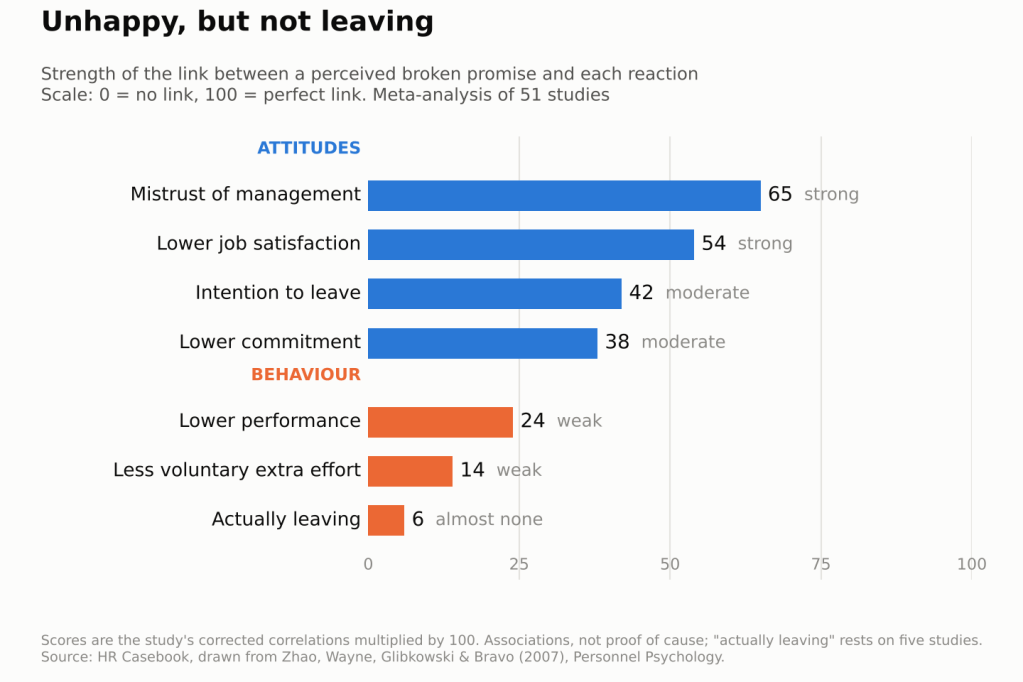
This quiet withdrawal should worry employers more than a wave of resignations would. These cuts are landing in a cooler labour market, where workers have fewer places to go. Attrition figures will look reassuring precisely because the people who would like to leave cannot easily do so. The cost will show up instead in engagement surveys, and in the discretionary effort nobody measures.
Nor is the damage fixed in advance: the way a cut is made matters almost as much as the cut itself. Sandra Robinson found that employees who trusted their employer beforehand lost less trust after a broken promise, and she and Elizabeth Morrison argued that a credible explanation is what stops disappointment from hardening into a sense of betrayal. Eight weeks of leave still beats what many American employers offer. Whether Deloitte’s staff see it that way will depend less on the arithmetic than on how the change was explained.
A few questions are worth asking before the memo goes out. Is the cut shared across the firm, or aimed at a lower-status group such as support staff? Is the notice generous? Do people hear about it from their manager or from the press? And is anything kept, or added, that signals the relationship still matters?
An employer can rewrite its benefits handbook overnight. The psychological contract has no such clause; it is renegotiated quietly, one unanswered email at a time.
Sources
Business Insider, via Yahoo Finance (2026). PTO, parental leave, pensions: Even the most prized benefits are on the chopping block.
Insurance Business (2026). Corporate round-up: Disney, Bloomberg, Starbucks, Deloitte, and Zoom cut benefits. 25 August.
Axios (2026). Large employers drop health benefits as costs rise. 4 September.
Zhao, H., Wayne, S. J., Glibkowski, B. C. and Bravo, J. (2007). The impact of psychological contract breach on work-related outcomes: A meta-analysis. Personnel Psychology, 60(3), 647-680.
Robinson, S. L. (1996). Trust and breach of the psychological contract. Administrative Science Quarterly.
Morrison, E. W. and Robinson, S. L. (1997). When employees feel betrayed: A model of how psychological contract violation develops. Academy of Management Review.


Leave a Reply