

From January, British employees can claim unfair dismissal after six months rather than two years. Past reforms suggest the real change will be in how firms choose and manage new starters, not in how many they hire.
In brief
- From January 1st 2027 British employees can claim unfair dismissal after six months’ service, not two years, with no compensation cap.
- When Britain cut the period in 1999, firing fell even among staff who gained nothing, which may reflect more careful recruitment.
- Probation becomes the period to decide, document and explain; reviews at months two and four may beat last-minute panic.
On January 1st 2027 a British employee will need only six months’ service, rather than two years, to bring a claim for unfair dismissal, and the cap on compensation disappears with it. Anyone hired on or before July 1st 2026 will be protected from New Year’s Day. Employers are nervous. In a CIPD survey published in February, more than a third said they planned to hire fewer permanent staff because of the Employment Rights Act, with the dismissal rules among the chief culprits.
Britain has been here before. The qualifying period has swung between six months and two years half a dozen times since it was introduced in 1971, typically shortening under Labour governments and lengthening under Conservative-led ones. That restlessness has one virtue: it has made the question unusually well studied.
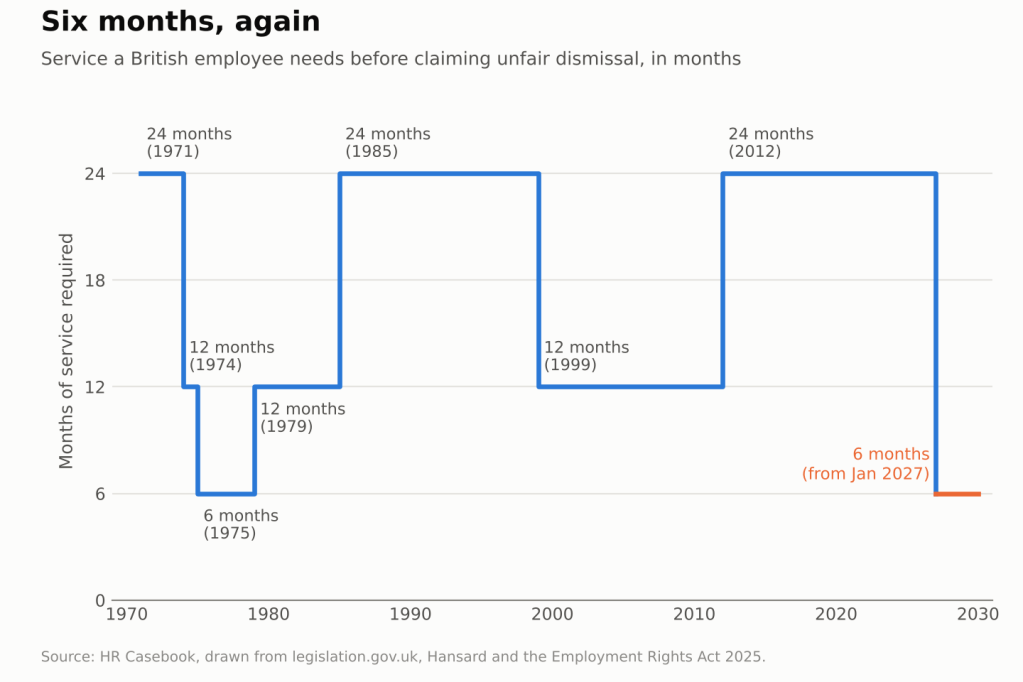
The best guide is a study by Ioana Marinescu of the 1999 reform, which cut the period from two years to one. Firing rates for workers with one to two years’ service, who were newly protected, fell by about a quarter relative to longer-serving staff. More surprising, firing also fell, by roughly a fifth, among those with less than a year’s service, who had gained nothing. She notes that this fits with employers choosing recruits more carefully once mistakes became costlier to undo.
The upshot is that protection seems to matter more for how firms hire than for how many they hire. When New Zealand made it easier to dismiss new staff in their first 90 days, Nathan Chappell and Isabelle Sin found little effect on how many people firms took on. Telling a pollster you will hire fewer people is one thing; turning away work because of a dismissal rule is another. Firms tend to hire the people they need, and may simply look a little harder at whom.
There is a less comforting flip side: a deadline invites games. In 2004 Germany exempted more small firms from its dismissal law, though staff already on their books kept their rights. Christine Luecke compared recruits in those firms who would be protected after six months with those who never would be. The first group were more likely to part company with the firm within the first six months, as though employers were clearing out doubtful hires before the door closed, although her data cannot tell who ended the job. Nor did she find that protection led to better matches. Probation, too often a form signed at month three and forgotten, becomes the period in which a firm must decide, document and explain. Managers who dislike difficult conversations will be tempted either to dismiss early “just in case” or to drift past the deadline and hope. Neither is good management, and from January the second becomes expensive.
Which leaves employers with a few questions. Could more care at the start, through structured interviews and honest previews of the job, mean fewer doubtful hires to worry about later? Should probation reviews come at months two and four rather than in the final week, when panic sets in? Who will train the line managers who make most of these calls? And will closer early scrutiny be applied evenly, rather than falling hardest on newcomers who were always least likely to be given the benefit of the doubt?
Six months is not long to get to know someone. Britain’s employers are about to find that it is long enough to have to explain why they let them go.
Sources
CIPD (2026). Employment Rights Act a handbrake on hiring: Labour Market Outlook, winter 2025/26. Press release, February.
Acas (2026). Employment Rights Act 2025: changes and timeline.
UK Government (2012). Explanatory memorandum to the Unfair Dismissal and Statement of Reasons for Dismissal (Variation of Qualifying Period) Order 2012. legislation.gov.uk.
Marinescu, I. (2009). Job security legislation and job duration: Evidence from the United Kingdom. Journal of Labor Economics, 27(3), 465-486.
Chappell, N. and Sin, I. (2020). The effect of trial periods in employment on firm hiring behavior. IZA Journal of Labor Policy.
Luecke, C. (2018). When protection puts you in jeopardy: How removing small-business clauses affects employment duration. LABOUR, 32(4), 213-236.


Leave a Reply